Amiga 500
The Amiga that ended up in millions of living rooms and bedrooms, and that the demoscene made its own.
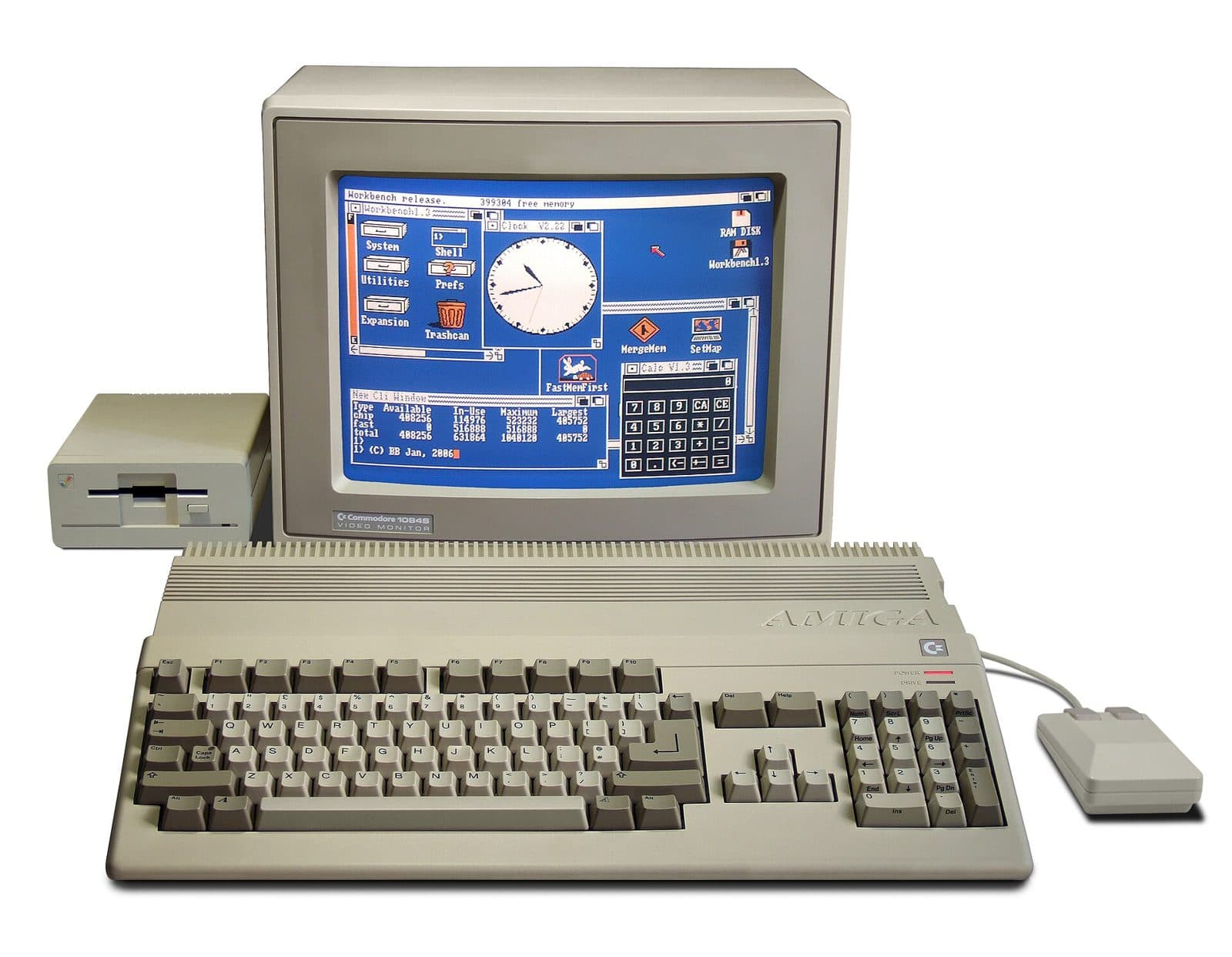
The Amiga 500 put the A1000's hardware inside the keyboard, at a home computer price. It became the best-selling Amiga and the reference machine for a generation of games and demos.
An Amiga for the home
In January 1987, at CES in Las Vegas, Commodore unveiled two new Amigas: the 2000, for professionals, and the 500, for the home. The A500, codenamed Rock Lobster, put the whole computer inside the keyboard case, with the floppy drive on the side and the power supply in an external brick. It reached the shops that year, at US$699 in the USA.
In Europe, and especially in the UK, Germany and Italy, the A500 was a phenomenon. With falling prices and bundles packed with games, it went on to vie with the Atari ST for the title of 16-bit computer of choice for gaming, programming and making music.
Inside
Its heart is the same as the A1000's: a Motorola 68000 at 7.09 MHz (PAL) and the OCS chips, with 512 KB of Chip RAM. The big difference is the Kickstart, which is now in ROM, first version 1.2 and later 1.3. Switch it on and the hand holding a floppy disk appears straight away, waiting for Workbench or a game.
Underneath there is a cover, the trapdoor, where the A501 expansion goes: another 512 KB of memory and a battery-backed clock. On the early models those extra 512 KB are not Chip RAM; they sit at a separate address and are called Slow RAM, because the processor accesses them with the same limitations as Chip RAM. On the side there is an 86-pin connector for hard drives and expansions, such as the A590.
Over its life there were several board revisions (3, 5, 6A, 8A). The 6A is the most common. The later versions have the ECS Agnus (8372A), which allows 1 MB of Chip RAM with a small modification.
The legacy
It is hard to overstate the A500's weight in European gaming culture. Studios such as Psygnosis, the Bitmap Brothers, Team17 and DMA Design (the makers of Lemmings) grew up with it. The demoscene, the groups who competed to pull off impossible real-time effects, treated the A500 with Kickstart 1.3 as the standard machine.
It is also the Amiga that reaches our bench most often: tired power supply capacitors, keyboards with worn membranes, floppy drives with dirty belts and heads, and A501 clock batteries leaking onto the board.
Trivia
- 10 REM
The 1989 Batman Pack in the UK bundled the A500 with the Batman game, The New Zealand Story, F/A-18 Interceptor and Deluxe Paint II. It is one of the bundles most people remember.
- 20 REM
Many games written for Kickstart 1.3 will not boot on later versions. That is why ROM switchers were sold (and are still fitted), so you can choose the Kickstart at power-up.
- 30 REM
The power LED dims when the low-pass audio filter is switched off. Some programs use this to show they are playing with the sound "open".
- 40 REM
The A501 expansion's battery is one of the most frequent causes of faults: when it leaks, it corrodes the traces on the expansion board and, sometimes, on the motherboard itself.
Try it
An Amiga running right here in your browser: press Switch on, wait for it to boot and explore the desktop with the mouse. It's the same kind of machine we have on the bench, only emulated.
It runs AROS, a free operating system compatible with AmigaOS: Commodore's original Kickstart ROMs are still under copyright and can't be distributed.
Emulation by vAmigaWeb (GPL-3.0).
AROS · vAmigaWeb
The family: Commodore Amiga
- 1985 Amiga 1000
- 1987 Amiga 500
- 1987 Amiga 2000
- 1990 Amiga 3000
- 1991 Amiga CDTV
- 1991 Amiga 500 Plus
- 1992 Amiga 600
- 1992 Amiga 1200
- 1992 Amiga 4000
- 1993 Amiga CD32
Compared with the other models
| Model | Year | Processor | Memory | Video | Sound | System |
|---|---|---|---|---|---|---|
| Amiga 1000 | 1985 | 68000 · 7,16 MHz | 256 KB | OCS | Paula · 4 × 8 bit | Kickstart 1.0–1.3 (disco) |
| ▶ Amiga 500 | 1987 | 68000 · 7,09 MHz | 512 KB | OCS / ECS | Paula · 4 × 8 bit | Kickstart 1.2 / 1.3 |
| Amiga 2000 | 1987 | 68000 · 7,09 MHz | 1 MB | OCS / ECS | Paula · 4 × 8 bit | Kickstart 1.2 / 1.3 |
| Amiga 3000 | 1990 | 68030 · 16 / 25 MHz | 2 MB | ECS | Paula · 4 × 8 bit | Kickstart 2.0 |
| Amiga CDTV | 1991 | 68000 · 7,09 MHz | 1 MB | OCS / ECS | Paula · 4 × 8 bit | Kickstart 1.3 + CDTV |
| Amiga 500 Plus | 1991 | 68000 · 7,09 MHz | 1 MB | ECS | Paula · 4 × 8 bit | Kickstart 2.04 |
| Amiga 600 | 1992 | 68000 · 7,09 MHz | 1 MB | ECS | Paula · 4 × 8 bit | Kickstart 2.05 |
| Amiga 1200 | 1992 | 68EC020 · 14 MHz | 2 MB | AGA | Paula · 4 × 8 bit | Kickstart 3.0 / 3.1 |
| Amiga 4000 | 1992 | 68040 · 25 MHz | 6 MB | AGA | Paula · 4 × 8 bit | Kickstart 3.0 / 3.1 |
| Amiga CD32 | 1993 | 68EC020 · 14 MHz | 2 MB | AGA + Akiko | Paula · 4 × 8 bit + CD | Kickstart 3.1 + CD32 |
Let me know when one arrives: Amiga 500
Looking for a particular model? Leave your email and we'll let you know when one comes into the shop.