DIP-48 · 8364R7 · drawing, not a photo
Amiga chipsCommodore (MOS / CSG)
1985
Paula
Four 8-bit voices, the floppy drive, the serial port and the interrupts: all in one chip.
Paula is the Amiga's sound chip, with four channels of 8-bit digital samples that play by themselves via DMA, but it also controls the floppy drives, the serial port, the analogue controllers and the interrupts. It was the same in every Amiga, from the A1000 to the CD32.
- 16
Portia, Glenn Keller's first chip
In the Lorraine prototypes it was called Portia. The design is by Glenn Keller, and it was the first chip he ever designed. It shipped in 1985 with the Amiga 1000, part number 8364, in a 48-pin DIP, and it's said that the name Paula comes from "Ports, Audio, UART and Logic": ports, audio, UART (the serial port) and logic.
The acronym sums the chip up well. Sound is the famous part, but Paula is also the Amiga's interrupt controller, the floppy drive controller, the serial port and the reader for the analogue controllers. People who have taken its silicon apart have found all of this, block by block, in a single chip.
Four voices
Paula has four sound channels. Each channel plays 8-bit digital (PCM) samples, which it fetches by itself from Chip RAM via DMA: the processor only has to say where the sound is, how long it is, how fast to play it and at what volume. Paula then repeats it until told to stop.
Each channel has its own frequency and its own volume, from 0 to 64. Via DMA, each channel reaches 28,867 samples per second, which gave crisp sound for the time. If the processor feeds Paula directly, or if the screen is in one of the faster scan modes of ECS or AGA, you can go beyond that.
The stereo is old-school: two channels go only to the left output and two only to the right, with nothing in between. That is why, on headphones, a lot of Amiga music has whole instruments on one side only. One channel can also modulate the volume or frequency of its neighbour, for vibrato and tremolo, but that was rarely used.
More than sound
The floppy controller is unusually flexible. It reads and writes the whole track in one go, raw, at 500 kbit/s in double density, and leaves the job of encoding and decoding the data to software (and to the Blitter). Because it doesn't need the gaps between sectors that PCs use, the same 3.5" disk that holds 720 KB on a PC holds 880 KB on an Amiga. And it reads odd formats: PC, Mac with the right drive, even Commodore 1541 disks with an adapted 5.25" drive.
The serial port is simple, with no buffer, but it accepts practically any speed, including MIDI's 31,250 baud. Paula also reads four analogue inputs (two per controller port), for paddles and analogue joysticks, and the second and third mouse buttons.
Finally, it is Paula that receives interrupt requests from 14 different sources (end of a sound, floppy ready, Copper, Blitter, serial port and others) and passes them to the 68000 on levels 1 to 6.
The chip that invented MOD music
In December 1987, the German Karsten Obarski released Ultimate Soundtracker, the first tracker: a program where music is written in columns, one per Paula channel, using instrument samples. The file format, MOD, stored the samples in 8 bits ready to play on Paula, so the music used very little processor time and fitted into games.
The original Soundtracker took 15 instruments. It was taken apart and improved by demoscene groups, and it was followed by NoiseTracker, by the Swedes Mahoney and Kaktus, in 1989, and ProTracker, in 1991, with 31 instruments. Many games used MODs as background music, and the format moved over to the PC and is still alive in the demoscene.
It was this four-voice music, with the stereo split down the middle and the sound slightly muffled by the output filter, that gave Amiga games their characteristic sound.
The chip that never changed
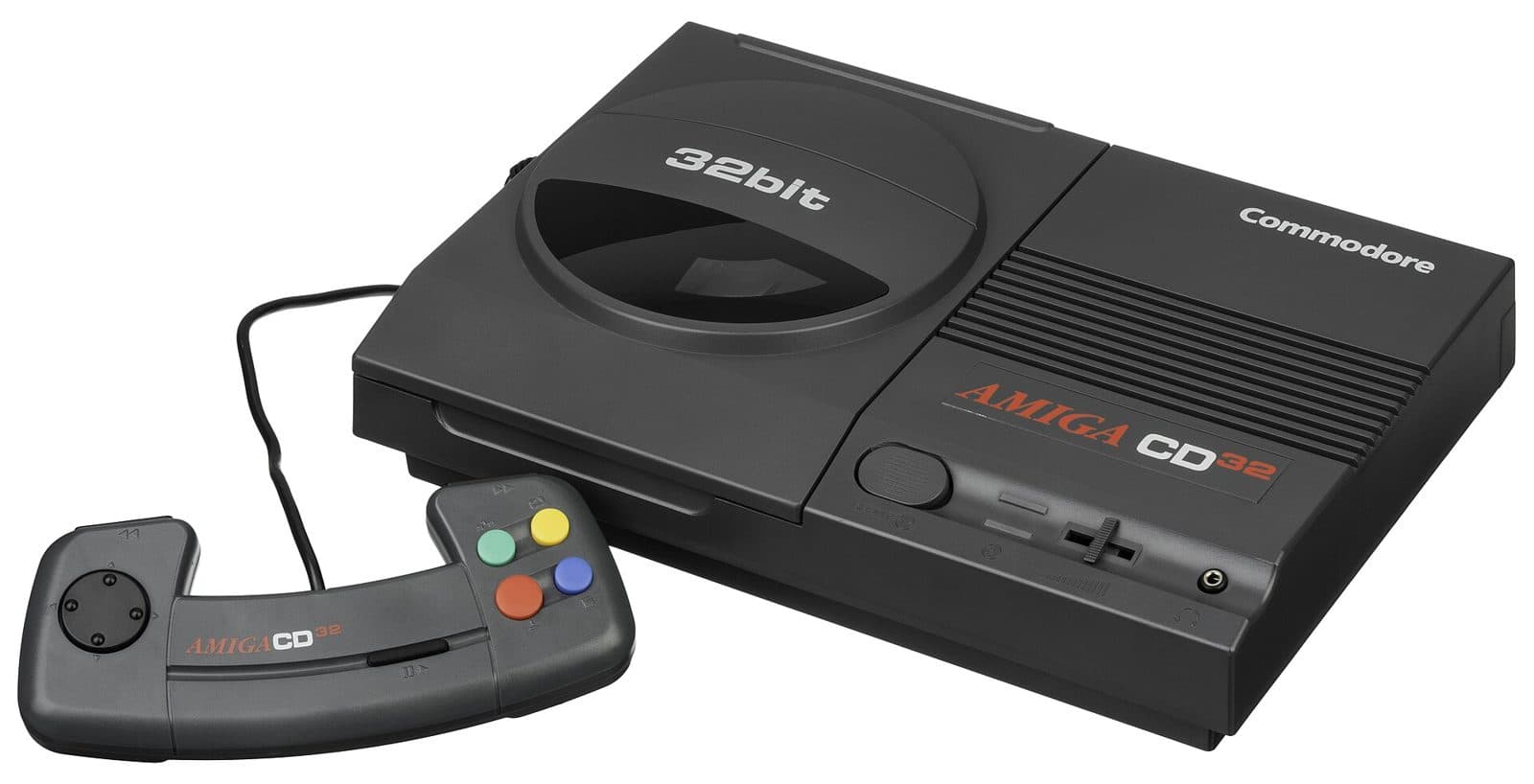
ECS and AGA changed Agnus and Denise, but Paula stayed the same: inside, it is functionally identical from the A1000 to the CD32. What changed was the package: in the A600, the A1200, the A4000 and the CD32 it appears as a 52-pin PLCC (8364R7PL), surface-mounted.
Since the hardware didn't change, the community kept squeezing more out of what was there. The AHI sound system uses a trick to play 14-bit sound: two channels play the same sample, one with the high part at maximum volume and the other with the low part at minimum volume, and the sum gives more resolution. You end up with two 14-bit channels instead of four 8-bit ones.
On the CD32, music on CD audio tracks doesn't go through Paula: there is a separate 16-bit converter on the board. Paula still handles the games' sound effects.
Did you know…
The story goes that Paula was also the name of the chip designer's girlfriend at the time.
Volume isn't done with an amplifier per channel: Paula switches the signal on and off very quickly (pulse-width modulation), and the average gives the requested volume.
The story goes that the Boing Ball's "boom" is a recording of Bob Pariseau hitting a garage door with a foam baseball bat.
MOD files have the mark "M.K." inside them. It is often said to be the initials of Mahoney and Kaktus; another version attributes them to Michael Kleps, another of the format's authors.
The filter that muffles the treble isn't in Paula, it's on the board, and it cuts off at around 3.3 kHz. When software turns it off, the power LED dims.
The high-density drives of the A3000 and A4000 are special: with HD disks they spin more slowly, so that Paula receives the data at the same rate as always.
On Amiga floppies, the sync word is normally $4489. Paula can search for it by itself while reading the track.
Paula's four channels
Paula plays four sounds at once, each with its own volume. There's no panning: two channels always come out on one side and the other two on the other. Most sources put 0 and 3 on the left (the third edition of Commodore's manual says the opposite). Listen with headphones.
Press a channel to hear which side it comes from.