Amiga 3000
The 32-bit Amiga for serious work: 68030, SCSI, Zorro III and a flicker-free picture.
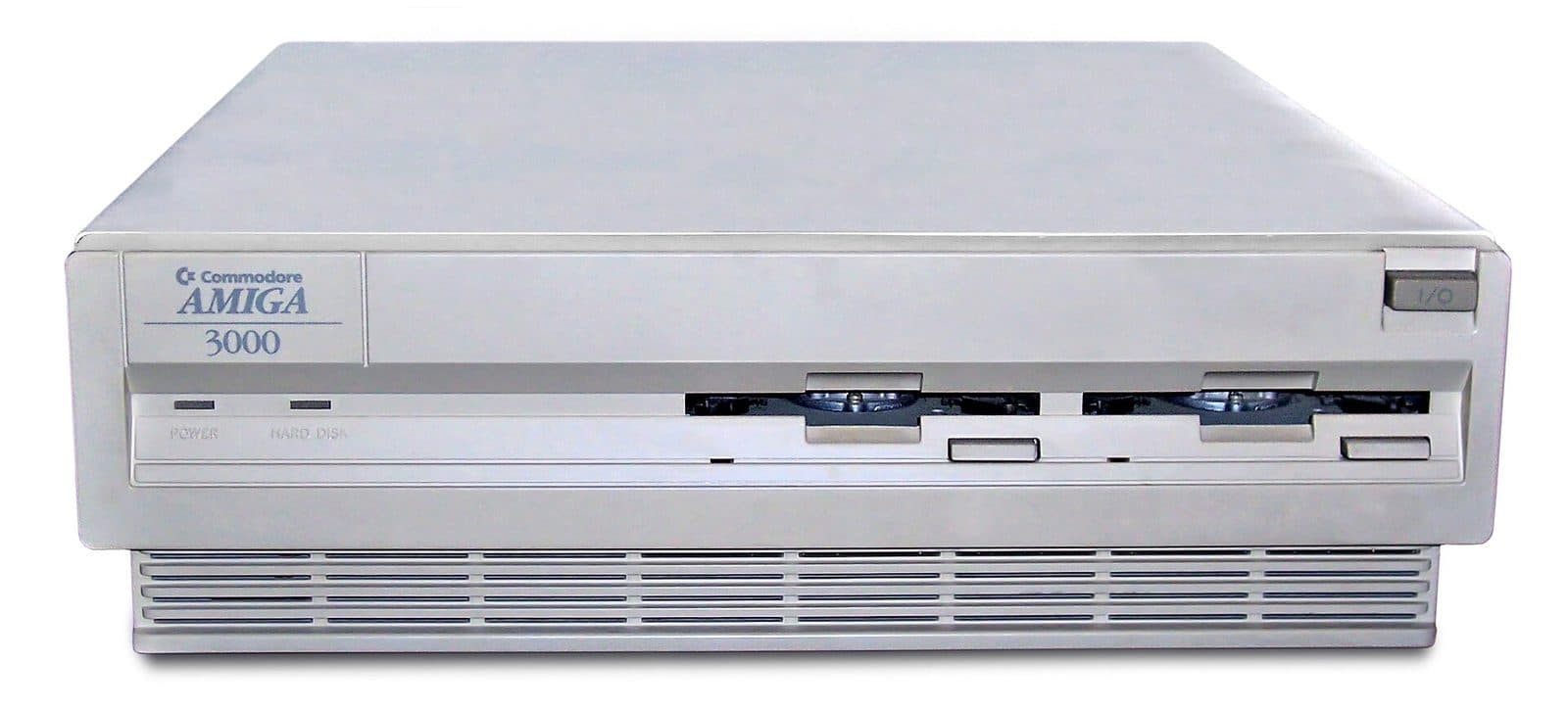
Launched in 1990, the Amiga 3000 brought a 32-bit 68030 processor, SCSI as standard, the Zorro III bus, the ECS chipset and Kickstart 2.0, with a new look for Workbench.
The leap to 32 bits
By 1990, 386 PCs and 68030 Macintoshes were already ahead of the A2000 in raw computing power. Commodore's answer was the A3000: a lower desktop case, with a Motorola 68030 at 16 or 25 MHz and a 68881 or 68882 maths coprocessor as standard.
It was the first Amiga with Kickstart 2.0 and with a completely redesigned Workbench, with the grey and blue bevelled look that defined the Amigas that followed.
Inside
The chipset is ECS (Enhanced Chip Set): the 2 MB version of the ECS Agnus addresses up to 2 MB of Chip RAM and the ECS Denise adds higher-resolution modes, such as Productivity (640 × 480 non-interlaced). The machine came with 2 MB of RAM, 1 MB Chip and 1 MB Fast, and took up to 16 MB of Fast RAM on the motherboard itself.
It had a built-in SCSI controller, which was rare, and it was the first with Zorro III, the 32-bit version of the expansion bus. It also included a de-interlacer (flicker fixer) that gave a stable 31 kHz picture on VGA monitors, putting an end to the flicker of the interlaced modes.
An Amiga with UNIX
There was an A3000UX version, sold with Amiga UNIX, an implementation of AT&T System V Release 4. For a while it was one of the cheapest UNIX workstations on the market.
Later came the A3000T as well, in a tower case, with more room for drives and cards.
Trivia
- 10 REM
The first units did not have Kickstart 2.0 in ROM: they loaded it from the hard drive, in a scheme called SuperKickstart. This also let you keep 1.3 to hand, for compatibility.
- 20 REM
The A3000 is the only classic Amiga with SCSI, Zorro III and a flicker fixer all as standard on the motherboard.
- 30 REM
The motherboard's clock battery is known for leaking and damaging the area around it. Removing it is one of the first things to do with an A3000 that arrives on the bench.
Try it
An Amiga running right here in your browser: press Switch on, wait for it to boot and explore the desktop with the mouse. It's the same kind of machine we have on the bench, only emulated.
It runs AROS, a free operating system compatible with AmigaOS: Commodore's original Kickstart ROMs are still under copyright and can't be distributed.
Emulation by vAmigaWeb (GPL-3.0).
AROS · vAmigaWeb
The family: Commodore Amiga
- 1985 Amiga 1000
- 1987 Amiga 500
- 1987 Amiga 2000
- 1990 Amiga 3000
- 1991 Amiga CDTV
- 1991 Amiga 500 Plus
- 1992 Amiga 600
- 1992 Amiga 1200
- 1992 Amiga 4000
- 1993 Amiga CD32
Compared with the other models
| Model | Year | Processor | Memory | Video | Sound | System |
|---|---|---|---|---|---|---|
| Amiga 1000 | 1985 | 68000 · 7,16 MHz | 256 KB | OCS | Paula · 4 × 8 bit | Kickstart 1.0–1.3 (disco) |
| Amiga 500 | 1987 | 68000 · 7,09 MHz | 512 KB | OCS / ECS | Paula · 4 × 8 bit | Kickstart 1.2 / 1.3 |
| Amiga 2000 | 1987 | 68000 · 7,09 MHz | 1 MB | OCS / ECS | Paula · 4 × 8 bit | Kickstart 1.2 / 1.3 |
| ▶ Amiga 3000 | 1990 | 68030 · 16 / 25 MHz | 2 MB | ECS | Paula · 4 × 8 bit | Kickstart 2.0 |
| Amiga CDTV | 1991 | 68000 · 7,09 MHz | 1 MB | OCS / ECS | Paula · 4 × 8 bit | Kickstart 1.3 + CDTV |
| Amiga 500 Plus | 1991 | 68000 · 7,09 MHz | 1 MB | ECS | Paula · 4 × 8 bit | Kickstart 2.04 |
| Amiga 600 | 1992 | 68000 · 7,09 MHz | 1 MB | ECS | Paula · 4 × 8 bit | Kickstart 2.05 |
| Amiga 1200 | 1992 | 68EC020 · 14 MHz | 2 MB | AGA | Paula · 4 × 8 bit | Kickstart 3.0 / 3.1 |
| Amiga 4000 | 1992 | 68040 · 25 MHz | 6 MB | AGA | Paula · 4 × 8 bit | Kickstart 3.0 / 3.1 |
| Amiga CD32 | 1993 | 68EC020 · 14 MHz | 2 MB | AGA + Akiko | Paula · 4 × 8 bit + CD | Kickstart 3.1 + CD32 |
Let me know when one arrives: Amiga 3000
Looking for a particular model? Leave your email and we'll let you know when one comes into the shop.