Amiga 1000
The first Amiga, and the computer that showed real multitasking and colour in 1985.
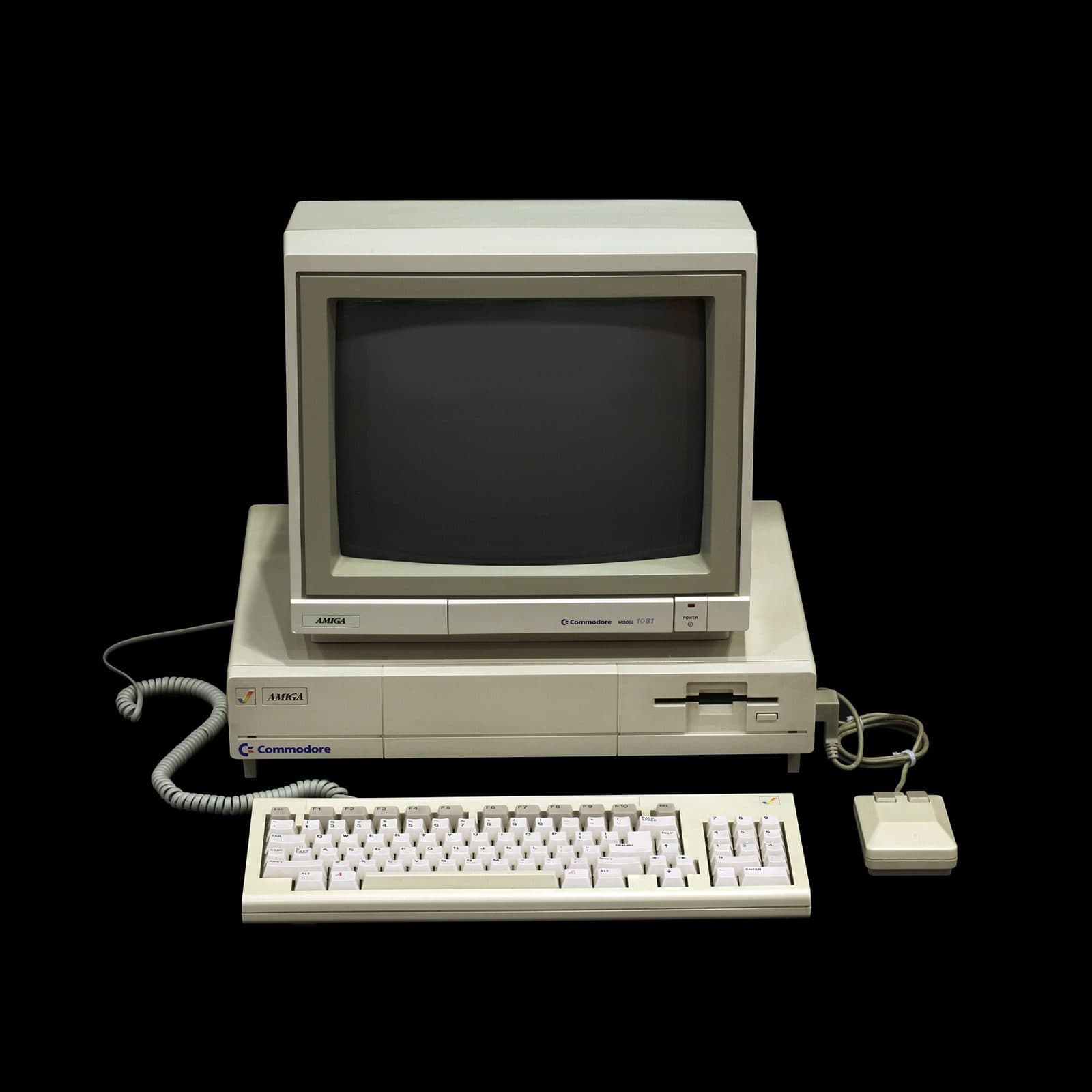
Launched in New York in July 1985, the Amiga 1000 paired a Motorola 68000 with three custom graphics and sound chips, and shipped with pre-emptive multitasking and a graphical interface as standard, at a personal-computer price.
From games console to computer
The story begins in 1982, at a small Californian company called Hi-Toro, which soon afterwards became Amiga Corporation. In charge of the hardware was Jay Miner, who had already designed the graphics chips for Atari's 8-bit consoles and computers. The original plan was a games console codenamed Lorraine; to pay the bills, the company sold peripherals for the Atari 2600, such as the Joyboard, a platform you played by moving your body.
The video game crash of 1983 forced a change of course: the console became a computer. Amiga ran out of money, accepted a loan from Atari and, in August 1984, was bought by Commodore, which paid off that loan and took over the team and the chips.
The Amiga 1000 was unveiled on 23 July 1985 at the Lincoln Center in New York, on an evening when Andy Warhol painted a portrait of Debbie Harry live, on the computer itself. It cost US$1,295, without a monitor.
Inside
The processor is a Motorola 68000 at 7.16 MHz (7.09 MHz in the European PAL versions), but the heavy lifting is done by three custom chips, the so-called OCS (Original Chip Set). Agnus controls memory access and includes the Blitter, which copies and combines blocks of image data without tying up the processor, and the Copper, a coprocessor that changes video registers in sync with the screen's beam. Denise generates the image and the sprites. Paula handles sound, the floppy drive and the serial ports.
The memory shared by the chips is called Chip RAM: the A1000 came with 256 KB, expandable to 512 KB with a card that slotted in at the front. In HAM (Hold-And-Modify) mode, Denise shows all 4,096 colours of the palette at once, something far ahead of any home computer of the time. Paula has four 8-bit digital sound channels, two for each side of the stereo image.
There is one quirk only the A1000 has: it does not have the Kickstart (the core of the system) in ROM. When you switch it on, it asks for a Kickstart disk and loads it into 256 KB of write-protected memory, the WOM (Write Once Memory). Only then does it ask for the Workbench disk. The disks are 3.5-inch, holding 880 KB.
The system
AmigaOS 1.0 had pre-emptive multitasking, something home PCs would only get many years later. The kernel, Exec, was written by Carl Sassenrath; the graphical interface is called Intuition and the desktop environment, Workbench. The part of AmigaDOS that manages files was adapted from TRIPOS, an academic system written in BCPL.
Commodore sold the A1000 as a machine for creative work: graphics, animation, music and video. It did not sell as well as it deserved, but it was the foundation for everything that came after.
Trivia
- 10 REM
Moulded inside the case lid are the signatures of the team that designed the machine, along with the paw print of Mitchy, Jay Miner's dog, who used to go to the office with him.
- 20 REM
It is said that the name Amiga ("female friend" in Spanish) was chosen because it sounded friendly and because it came before Apple and Atari in alphabetical order.
- 30 REM
The system's fatal error is called Guru Meditation. The expression comes from the Joyboard: to unwind between tests, the team would sit motionless on it, as if meditating, in a game that warned you when someone moved.
- 40 REM
The famous Boing Ball, the red and white chequered ball, was written by Dale Luck and R. J. Mical and shown at the January 1984 CES, still on a prototype full of boards.
- 50 REM
The keyboard tucks away under the computer, in a sort of garage in the base of the case.
Try it
An Amiga running right here in your browser: press Switch on, wait for it to boot and explore the desktop with the mouse. It's the same kind of machine we have on the bench, only emulated.
It runs AROS, a free operating system compatible with AmigaOS: Commodore's original Kickstart ROMs are still under copyright and can't be distributed.
Emulation by vAmigaWeb (GPL-3.0).
AROS · vAmigaWeb
The family: Commodore Amiga
- 1985 Amiga 1000
- 1987 Amiga 500
- 1987 Amiga 2000
- 1990 Amiga 3000
- 1991 Amiga CDTV
- 1991 Amiga 500 Plus
- 1992 Amiga 600
- 1992 Amiga 1200
- 1992 Amiga 4000
- 1993 Amiga CD32
Compared with the other models
| Model | Year | Processor | Memory | Video | Sound | System |
|---|---|---|---|---|---|---|
| ▶ Amiga 1000 | 1985 | 68000 · 7,16 MHz | 256 KB | OCS | Paula · 4 × 8 bit | Kickstart 1.0–1.3 (disco) |
| Amiga 500 | 1987 | 68000 · 7,09 MHz | 512 KB | OCS / ECS | Paula · 4 × 8 bit | Kickstart 1.2 / 1.3 |
| Amiga 2000 | 1987 | 68000 · 7,09 MHz | 1 MB | OCS / ECS | Paula · 4 × 8 bit | Kickstart 1.2 / 1.3 |
| Amiga 3000 | 1990 | 68030 · 16 / 25 MHz | 2 MB | ECS | Paula · 4 × 8 bit | Kickstart 2.0 |
| Amiga CDTV | 1991 | 68000 · 7,09 MHz | 1 MB | OCS / ECS | Paula · 4 × 8 bit | Kickstart 1.3 + CDTV |
| Amiga 500 Plus | 1991 | 68000 · 7,09 MHz | 1 MB | ECS | Paula · 4 × 8 bit | Kickstart 2.04 |
| Amiga 600 | 1992 | 68000 · 7,09 MHz | 1 MB | ECS | Paula · 4 × 8 bit | Kickstart 2.05 |
| Amiga 1200 | 1992 | 68EC020 · 14 MHz | 2 MB | AGA | Paula · 4 × 8 bit | Kickstart 3.0 / 3.1 |
| Amiga 4000 | 1992 | 68040 · 25 MHz | 6 MB | AGA | Paula · 4 × 8 bit | Kickstart 3.0 / 3.1 |
| Amiga CD32 | 1993 | 68EC020 · 14 MHz | 2 MB | AGA + Akiko | Paula · 4 × 8 bit + CD | Kickstart 3.1 + CD32 |
Let me know when one arrives: Amiga 1000
Looking for a particular model? Leave your email and we'll let you know when one comes into the shop.