ZX Spectrum 16K / 48K
Rubber keys, eight colours and thousands of games on cassette.
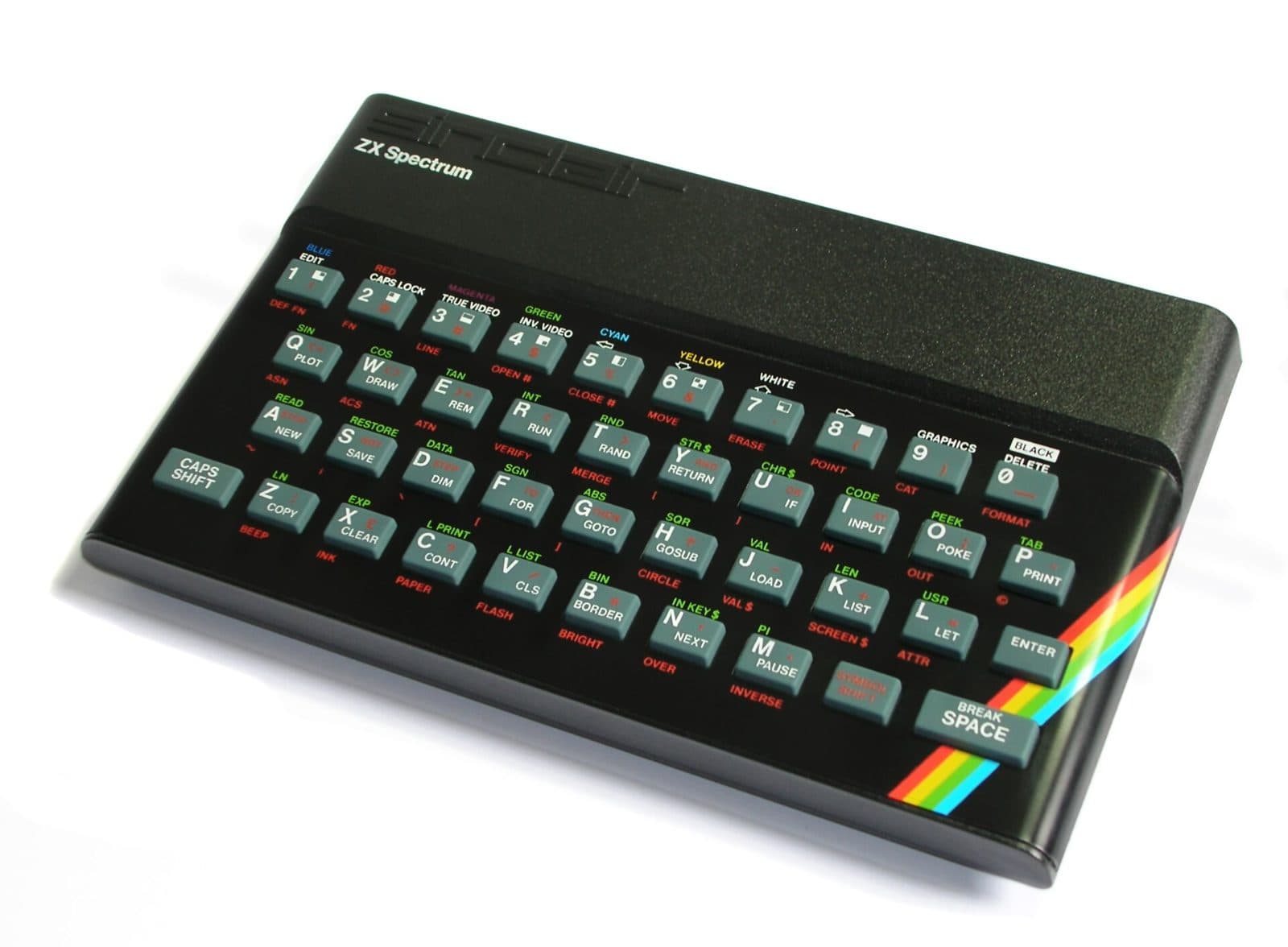
Launched on 23 April 1982 by Sinclair Research, the ZX Spectrum (16K and 48K) put a colour computer into millions of European homes at a low price, and launched an entire games industry.
A cheap colour computer
After the black-and-white ZX80 and ZX81, Clive Sinclair's Sinclair Research wanted a colour computer that cost little. The ZX Spectrum was unveiled on 23 April 1982, in two versions: 16 KB for £125 and 48 KB for £175. The name comes from the colour spectrum, which is also where the rainbow stripe in the corner comes from.
The hardware was designed by Richard Altwasser, the ROM with Sinclair BASIC was written by Steve Vickers of Nine Tiles, and the black case with rubber keys is by Rick Dickinson. It was manufactured by Timex, in Dundee, Scotland.
Inside
The processor is a Zilog Z80A at 3.5 MHz. Almost everything else is in a single chip, the ULA (Uncommitted Logic Array) made by Ferranti, which generates the picture, reads the keyboard, handles the cassette and produces the sound.
The picture is 256 × 192 pixels, but colour is set in 8 × 8 blocks: each block can only have two colours, ink and paper. When two characters of different colours cross, the colours "bleed" into each other, the famous attribute clash. There are eight colours, each with a normal and a bright version, and black does not change, which gives 15 distinct colours.
The sound is a 1-bit beeper, which programmers managed to make play two and three voices through sheer ingenuity. Programs load from cassette at about 1,500 bits per second, with coloured stripes in the screen border showing the data going by.
In Portugal and around the world
The Spectrum was the computer of a generation in the UK and across much of Europe. In Portugal it had a special presence because of Timex, which had a factory in the country and made the Spectrum-compatible Timex Computer 2048 and 2068 there.
There were clones all over the place: the TK90X in Brazil, dozens of models in the Soviet Union and Eastern Europe. Games such as Manic Miner, Jet Set Willy and Knight Lore came out of bedrooms and garages and founded studios that still exist today.
Trivia
- 10 REM
Each key carries several keywords: instead of typing PRINT letter by letter, you press one key and the whole word appears. The cursor changes letter (K, L, E, G) depending on the mode.
- 20 REM
At the time, the rubber keyboard was described as having the feel of "dead flesh".
- 30 REM
Clive Sinclair was knighted in 1983, largely thanks to the Spectrum's success.
- 40 REM
The 16K could be upgraded to 48K with an internal memory expansion.
- 50 REM
There were several board revisions ("issues" 1 to 6). Issue 2 and issue 3 behave differently when reading the keyboard port, and some games only work on one of them.
Try it
On the 48K each key types a whole word: press P and PRINT appears. Quotes are Ctrl + P. Try PRINT "HELLO" and ENTER.
Emulation by JSSpeccy 3 (GPL-3.0). The Spectrum ROM belongs to Amstrad, which allows it to be distributed with emulators.
© 1982 Sinclair Research Ltd
The family: Sinclair
- 1977 Science of Cambridge MK14
- 1980 Sinclair ZX80
- 1981 Sinclair ZX81
- 1982 ZX Spectrum 16K / 48K
- 1984 ZX Spectrum+
- 1984 Sinclair QL
- 1985 ZX Spectrum 128
- 1986 ZX Spectrum +2
- 1987 ZX Spectrum +3
- 1987 ZX Spectrum +2A / +2B
- 2017 ZX Spectrum Next
Compared with the other models
| Model | Year | Processor | Memory | Video | Sound | System |
|---|---|---|---|---|---|---|
| Science of Cambridge MK14 | 1977 | SC/MP · 4,43 MHz | 256 B | LED 7 segmentos | — | Monitor 512 B |
| Sinclair ZX80 | 1980 | Z80A · 3,25 MHz | 1 KB (16 KB) | TTL · 32 × 24 mono | — | 4K BASIC |
| Sinclair ZX81 | 1981 | Z80A · 3,25 MHz | 1 KB (16 KB) | ULA · 32 × 24 mono | — | 8K BASIC |
| ▶ ZX Spectrum 16K / 48K | 1982 | Z80A · 3,5 MHz | 16 / 48 KB | ULA · 256 × 192 | Beeper 1 bit | 48 BASIC |
| ZX Spectrum+ | 1984 | Z80A · 3,5 MHz | 48 KB | ULA · 256 × 192 | Beeper 1 bit | 48 BASIC |
| Sinclair QL | 1984 | 68008 · 7,5 MHz | 128 KB | ZX8301 · 512 × 256 | 8049 · beeper | QDOS + SuperBASIC |
| ZX Spectrum 128 | 1985 | Z80A · 3,55 MHz | 128 KB | ULA · 256 × 192 | AY-3-8912 · 3 ch | 128 BASIC |
| ZX Spectrum +2 | 1986 | Z80A · 3,55 MHz | 128 KB | ULA · 256 × 192 | AY-3-8912 · 3 ch | 128 BASIC |
| ZX Spectrum +3 | 1987 | Z80A · 3,55 MHz | 128 KB | Gate array · 256 × 192 | AY-3-8912 · 3 ch | +3 BASIC + +3DOS |
| ZX Spectrum +2A / +2B | 1987 | Z80A · 3,55 MHz | 128 KB | Gate array · 256 × 192 | AY-3-8912 · 3 ch | +3 BASIC |
| ZX Spectrum Next | 2017 | Z80N (FPGA) · até 28 MHz | 1 MB | FPGA · HDMI / VGA | 3 × AY + DAC | NextZXOS |
Let me know when one arrives: ZX Spectrum 16K / 48K
Looking for a particular model? Leave your email and we'll let you know when one comes into the shop.