ZX Spectrum +2
Amstrad's first Spectrum, grey and with a built-in cassette deck.
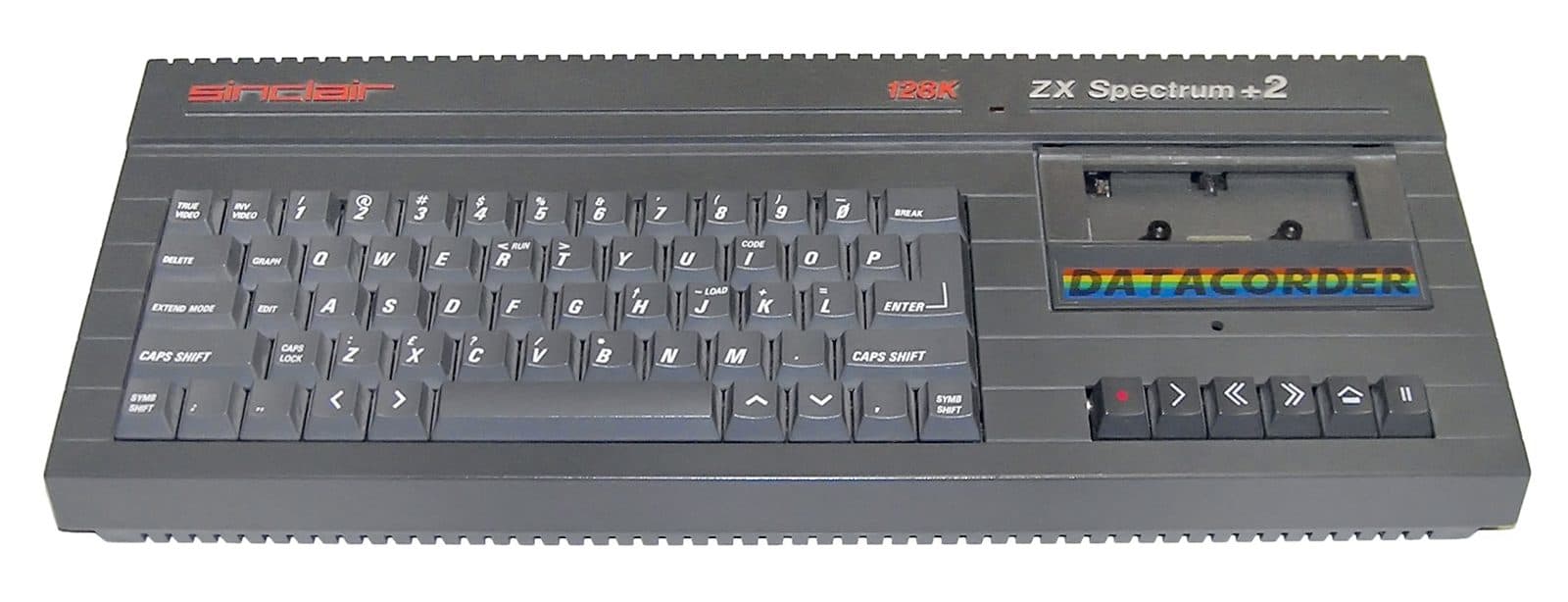
The 1986 ZX Spectrum +2 was the first Spectrum made by Amstrad: a 128 in a grey case, with a keyboard of mechanical keys, an integrated cassette recorder and two joystick ports.
Amstrad buys Sinclair
In April 1986 Alan Sugar's Amstrad bought the Sinclair brand and the rights to its computers for £5 million. The first result was the +2, launched that year: Amstrad took the 128 and put it in a grey case in the style of its CPCs, with a cassette recorder, the Datacorder, built into the right-hand side.
The aim was clear: to sell a complete games machine, ready to plug into the television, with no cables to the tape recorder and no fiddling with the volume.
Inside
The electronics are practically those of the 128: Z80A at 3.5469 MHz, 128 KB of RAM, AY sound chip and the same start-up menu. The keyboard now has full-travel keys and there are two joystick ports on the left.
The joystick ports follow the Sinclair Interface 2 wiring, but the pins are different from common Atari joysticks. You need an adapter or a dedicated joystick to use them.
Trivia
- 10 REM
The integrated Datacorder is one of the parts that most often needs servicing: belts, rubber pinch rollers and misaligned read heads.
- 20 REM
Like the 128, it boots into a menu and can switch to 48 BASIC mode, where most older games run.
Try it
Choose “128 BASIC” with ENTER. Here commands are typed letter by letter: try PRINT "HELLO" and ENTER. Quotes are Ctrl + P.
Emulation by JSSpeccy 3 (GPL-3.0). The Spectrum ROM belongs to Amstrad, which allows it to be distributed with emulators.
© 1982 Sinclair Research Ltd
The family: Sinclair
- 1977 Science of Cambridge MK14
- 1980 Sinclair ZX80
- 1981 Sinclair ZX81
- 1982 ZX Spectrum 16K / 48K
- 1984 ZX Spectrum+
- 1984 Sinclair QL
- 1985 ZX Spectrum 128
- 1986 ZX Spectrum +2
- 1987 ZX Spectrum +3
- 1987 ZX Spectrum +2A / +2B
- 2017 ZX Spectrum Next
Compared with the other models
| Model | Year | Processor | Memory | Video | Sound | System |
|---|---|---|---|---|---|---|
| Science of Cambridge MK14 | 1977 | SC/MP · 4,43 MHz | 256 B | LED 7 segmentos | — | Monitor 512 B |
| Sinclair ZX80 | 1980 | Z80A · 3,25 MHz | 1 KB (16 KB) | TTL · 32 × 24 mono | — | 4K BASIC |
| Sinclair ZX81 | 1981 | Z80A · 3,25 MHz | 1 KB (16 KB) | ULA · 32 × 24 mono | — | 8K BASIC |
| ZX Spectrum 16K / 48K | 1982 | Z80A · 3,5 MHz | 16 / 48 KB | ULA · 256 × 192 | Beeper 1 bit | 48 BASIC |
| ZX Spectrum+ | 1984 | Z80A · 3,5 MHz | 48 KB | ULA · 256 × 192 | Beeper 1 bit | 48 BASIC |
| Sinclair QL | 1984 | 68008 · 7,5 MHz | 128 KB | ZX8301 · 512 × 256 | 8049 · beeper | QDOS + SuperBASIC |
| ZX Spectrum 128 | 1985 | Z80A · 3,55 MHz | 128 KB | ULA · 256 × 192 | AY-3-8912 · 3 ch | 128 BASIC |
| ▶ ZX Spectrum +2 | 1986 | Z80A · 3,55 MHz | 128 KB | ULA · 256 × 192 | AY-3-8912 · 3 ch | 128 BASIC |
| ZX Spectrum +3 | 1987 | Z80A · 3,55 MHz | 128 KB | Gate array · 256 × 192 | AY-3-8912 · 3 ch | +3 BASIC + +3DOS |
| ZX Spectrum +2A / +2B | 1987 | Z80A · 3,55 MHz | 128 KB | Gate array · 256 × 192 | AY-3-8912 · 3 ch | +3 BASIC |
| ZX Spectrum Next | 2017 | Z80N (FPGA) · até 28 MHz | 1 MB | FPGA · HDMI / VGA | 3 × AY + DAC | NextZXOS |
Let me know when one arrives: ZX Spectrum +2
Looking for a particular model? Leave your email and we'll let you know when one comes into the shop.