Science of Cambridge MK14
The £39.95 kit where it all began: 256 bytes of memory and an LED display.
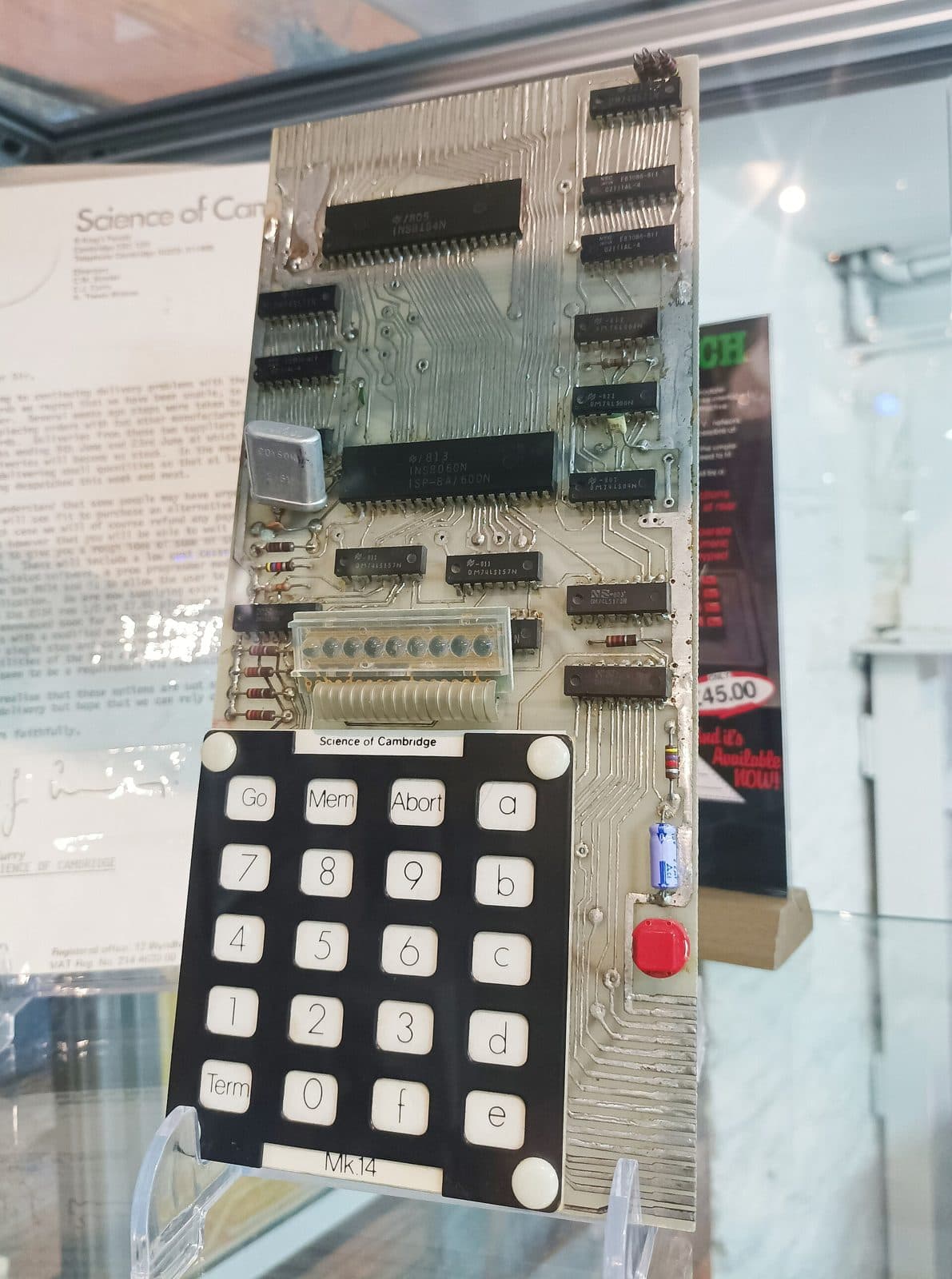
The MK14, from Clive Sinclair's Science of Cambridge, was a kit computer launched in 1977: a board with an SC/MP processor, 256 bytes of memory, a hexadecimal keypad and an LED display, for £39.95.
A computer on a board
In 1977, Clive Sinclair and Chris Curry set up Science of Cambridge to sell cheap electronics by mail order. The MK14 (Microcomputer Kit 14) was a board to assemble at home, based on a National Semiconductor reference design, and it cost £39.95.
There was no case and no TV connection: you programmed it directly in machine code, in hexadecimal, and the result appeared on a small seven-segment LED display.
Inside
The processor is a National Semiconductor SC/MP (INS8060), with a 4.43 MHz crystal, the same frequency used in PAL colour televisions, which made it cheap. Standard memory is 256 bytes, and a small 512-byte monitor program in ROM lets you read and write memory and run programs.
The keypad has 20 keys: the 16 hexadecimal digits and four command keys. With expansions it was possible to add memory and connect a cassette recorder.
The legacy
The MK14 showed Clive Sinclair that there was demand for cheap computers, and the ZX80 grew out of that. Chris Curry left shortly afterwards and founded Acorn, the company that would make the BBC Micro and, later, the ARM processors.
Trivia
- 10 REM
The 4.43 MHz crystal is the PAL colour one: produced by the million for televisions, it cost very little.
- 20 REM
Programs were published in magazines as lists of hexadecimal numbers, to be typed in key by key.
- 30 REM
Today there are replicas and emulators of the MK14 for anyone who wants to try it without risking an original board.
The family: Sinclair
- 1977 Science of Cambridge MK14
- 1980 Sinclair ZX80
- 1981 Sinclair ZX81
- 1982 ZX Spectrum 16K / 48K
- 1984 ZX Spectrum+
- 1984 Sinclair QL
- 1985 ZX Spectrum 128
- 1986 ZX Spectrum +2
- 1987 ZX Spectrum +3
- 1987 ZX Spectrum +2A / +2B
- 2017 ZX Spectrum Next
Compared with the other models
| Model | Year | Processor | Memory | Video | Sound | System |
|---|---|---|---|---|---|---|
| ▶ Science of Cambridge MK14 | 1977 | SC/MP · 4,43 MHz | 256 B | LED 7 segmentos | — | Monitor 512 B |
| Sinclair ZX80 | 1980 | Z80A · 3,25 MHz | 1 KB (16 KB) | TTL · 32 × 24 mono | — | 4K BASIC |
| Sinclair ZX81 | 1981 | Z80A · 3,25 MHz | 1 KB (16 KB) | ULA · 32 × 24 mono | — | 8K BASIC |
| ZX Spectrum 16K / 48K | 1982 | Z80A · 3,5 MHz | 16 / 48 KB | ULA · 256 × 192 | Beeper 1 bit | 48 BASIC |
| ZX Spectrum+ | 1984 | Z80A · 3,5 MHz | 48 KB | ULA · 256 × 192 | Beeper 1 bit | 48 BASIC |
| Sinclair QL | 1984 | 68008 · 7,5 MHz | 128 KB | ZX8301 · 512 × 256 | 8049 · beeper | QDOS + SuperBASIC |
| ZX Spectrum 128 | 1985 | Z80A · 3,55 MHz | 128 KB | ULA · 256 × 192 | AY-3-8912 · 3 ch | 128 BASIC |
| ZX Spectrum +2 | 1986 | Z80A · 3,55 MHz | 128 KB | ULA · 256 × 192 | AY-3-8912 · 3 ch | 128 BASIC |
| ZX Spectrum +3 | 1987 | Z80A · 3,55 MHz | 128 KB | Gate array · 256 × 192 | AY-3-8912 · 3 ch | +3 BASIC + +3DOS |
| ZX Spectrum +2A / +2B | 1987 | Z80A · 3,55 MHz | 128 KB | Gate array · 256 × 192 | AY-3-8912 · 3 ch | +3 BASIC |
| ZX Spectrum Next | 2017 | Z80N (FPGA) · até 28 MHz | 1 MB | FPGA · HDMI / VGA | 3 × AY + DAC | NextZXOS |
Let me know when one arrives: Science of Cambridge MK14
Looking for a particular model? Leave your email and we'll let you know when one comes into the shop.