Sinclair ZX81
The Spectrum's predecessor: 1 KB of memory, black and white, and sold as a kit to build at home.
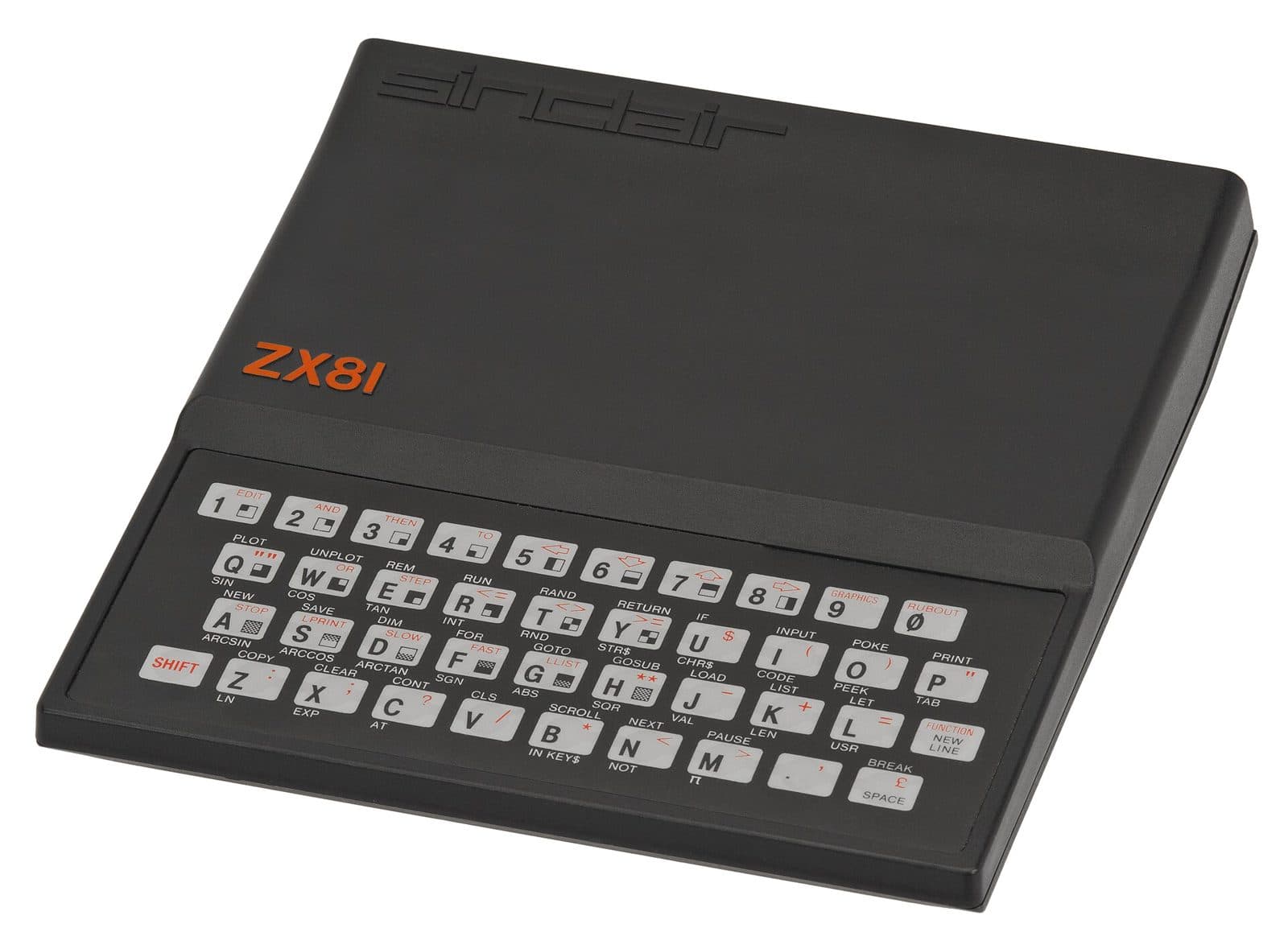
Launched in March 1981, Sinclair Research's ZX81 cost £49.95 as a kit and £69.95 assembled. With very few chips and 1 KB of memory, it was many people's first computer.
A computer for under £100
In 1980 Sinclair had launched the ZX80, the first computer on sale in the UK for under £100. The ZX81 arrived in March 1981 and took the idea further: fewer components, cheaper to make and more capable.
It was sold in two ways: as a kit, for £49.95, to assemble and solder at home, or ready-built, for £69.95. It was made by Timex in Dundee, Scotland, and in the US Timex sold its own version, the Timex Sinclair 1000, with 2 KB of memory.
Inside
The processor is a Zilog Z80A at 3.25 MHz. Much of the logic that was spread over several chips in the ZX80 moved into a single custom chip, the ULA made by Ferranti, leaving the board with very few components.
Standard memory is 1 KB. For bigger programs there was the 16 KB RAM pack, which plugged into the rear port. The 8 KB ROM holds Sinclair BASIC, an evolution of the ZX80's BASIC, written at Nine Tiles by Steve Vickers and John Grant.
The picture is black and white, 32 × 24 characters of text, with block graphics. The processor itself helps generate the picture, so the ZX81 has two modes: SLOW, where the picture stays up while the program runs, and FAST, which is quicker but blanks the screen during calculations.
The legacy
The ZX81 sold over a million units and was, for many people, their first contact with a computer. The thin black case, designed by Rick Dickinson, and the flat membrane keyboard defined Sinclair's image before the Spectrum.
There were clones in several countries, such as Microdigital's TK82 and TK85 in Brazil.
Trivia
- 10 REM
The 16 KB RAM pack was notorious for wobbling: one nudge to the computer was enough to lose the connection, and the program with it. Many people fixed it in place with sticky tape or Blu-Tack.
- 20 REM
3D Monster Maze, by Malcolm Evans, is often cited as one of the first 3D games for home computers.
- 30 REM
The ZX Printer printed on silvery paper, burning away the aluminium layer with small electrical sparks.
- 40 REM
The cursor at power-up is an inverse-video K: it means the next key is read as a keyword (PRINT, LET, GOTO…).
- 50 REM
The keyboard has no moving keys: it's a flat membrane with the keys printed on it.
The family: Sinclair
- 1977 Science of Cambridge MK14
- 1980 Sinclair ZX80
- 1981 Sinclair ZX81
- 1982 ZX Spectrum 16K / 48K
- 1984 ZX Spectrum+
- 1984 Sinclair QL
- 1985 ZX Spectrum 128
- 1986 ZX Spectrum +2
- 1987 ZX Spectrum +3
- 1987 ZX Spectrum +2A / +2B
- 2017 ZX Spectrum Next
Compared with the other models
| Model | Year | Processor | Memory | Video | Sound | System |
|---|---|---|---|---|---|---|
| Science of Cambridge MK14 | 1977 | SC/MP · 4,43 MHz | 256 B | LED 7 segmentos | — | Monitor 512 B |
| Sinclair ZX80 | 1980 | Z80A · 3,25 MHz | 1 KB (16 KB) | TTL · 32 × 24 mono | — | 4K BASIC |
| ▶ Sinclair ZX81 | 1981 | Z80A · 3,25 MHz | 1 KB (16 KB) | ULA · 32 × 24 mono | — | 8K BASIC |
| ZX Spectrum 16K / 48K | 1982 | Z80A · 3,5 MHz | 16 / 48 KB | ULA · 256 × 192 | Beeper 1 bit | 48 BASIC |
| ZX Spectrum+ | 1984 | Z80A · 3,5 MHz | 48 KB | ULA · 256 × 192 | Beeper 1 bit | 48 BASIC |
| Sinclair QL | 1984 | 68008 · 7,5 MHz | 128 KB | ZX8301 · 512 × 256 | 8049 · beeper | QDOS + SuperBASIC |
| ZX Spectrum 128 | 1985 | Z80A · 3,55 MHz | 128 KB | ULA · 256 × 192 | AY-3-8912 · 3 ch | 128 BASIC |
| ZX Spectrum +2 | 1986 | Z80A · 3,55 MHz | 128 KB | ULA · 256 × 192 | AY-3-8912 · 3 ch | 128 BASIC |
| ZX Spectrum +3 | 1987 | Z80A · 3,55 MHz | 128 KB | Gate array · 256 × 192 | AY-3-8912 · 3 ch | +3 BASIC + +3DOS |
| ZX Spectrum +2A / +2B | 1987 | Z80A · 3,55 MHz | 128 KB | Gate array · 256 × 192 | AY-3-8912 · 3 ch | +3 BASIC |
| ZX Spectrum Next | 2017 | Z80N (FPGA) · até 28 MHz | 1 MB | FPGA · HDMI / VGA | 3 × AY + DAC | NextZXOS |
Let me know when one arrives: Sinclair ZX81
Looking for a particular model? Leave your email and we'll let you know when one comes into the shop.