PLCC-84 · 391155-01 · drawing, not a photo
Amiga chipsCommodore
1992
Gayle
The Gary of the nineties: the same glue, plus the IDE disk and the PCMCIA slot, in one 84-pin chip.
Gayle is the gate array that replaced Gary in the A600 and A1200. It does the address decoding and DTACK as Gary did, and adds the IDE hard disk controller, the PCMCIA interface, the real-time clock, the reset and the floppy logic. Commodore's specification is from June 1991, for the machine still called the A300.
A chip for a smaller Amiga
In 1991 Commodore was designing a small, cheap Amiga, the A300, which reached the shops in 1992 as the A600. For it they needed a glue chip that did more than Gary: the new machine had an optional 2.5-inch IDE hard disk and a slot for PCMCIA cards, and neither existed in earlier Amigas. The answer was Gayle, an 84-pin gate array in a PLCC, and the specification says at once what it is for: running a 68000 Amiga with the ECS chipset at 7.16 MHz.
The list of functions has thirteen points. Decoding and timing for the ROM, for an optional flash ROM, for Chip RAM, for the chip registers, for the two CIAs, for the real-time clock, for the card connector, for the IDE disk and for an ARCNET network chip; generation of the CIAs' E clock; data buffer control; the system reset; and the floppy glue. Everything Gary did, and the rest.
The A1200, of 1992, carries a variant, the AA Gayle, for the AGA-chipset machine. The part numbers differ (391155 in the A600, 391424 in the A1200) and the chips are not swapped between the two machines.
The hard disk enters the map
The most visible novelty is IDE. Gayle produces the two chip selects an AT disk needs and the read and write signals with the right timing, and places the disk's registers at address $DA0000. There are two kinds of access: the control registers are read 8 bits wide, and the data register 16 bits wide, faster. The specification carries the register map just as it is in PCs, from the data register to the command register, with the disk's address bits wired to the processor's bits A2 to A4.
Today few A600s and A1200s in use have a mechanical disk: they carry a CompactFlash card or a memory module in its place, and it is through Gayle that they go.
The chip also provides for an optional flash ROM, at $A00000, meant to replace the floppy drive in an even cheaper version of the A300. As far as anyone knows it never came to be, but the address space stayed there.
- $000000Chip RAM
- $200000Zorro II expansion
- $400000PCMCIA: memory
- $800000PCMCIA: attributes
- $900000PCMCIA: I/O
- $A00000Flash ROM (optional)
- $A80000Workbench ROM (optional)
- $B80000No use in the chip
- $BF0000CIAs ($BFD000, $BFE001)
- $C00000Expansion memory ($C00000)
- $D80000No use in the chip
- $D90000ARCNET (optional)
- $DA0000IDE (disk registers)
- $DA8000PCMCIA and IDE: configuration
- $DB0000No use in the chip
- $DC0000Real-time clock
- $DD0000No use in the chip
- $DF0000Chip registers ($DFF000)
- $E00000Kickstart ROM
- $E80000Configuration and I/O cards
- $F00000Cartridge
- $F80000Kickstart ROM
Stripes: ROM at the lowest addresses at start-up (OVL). 24-bit addresses; in the bar, the small blocks are widened so they can be seen. Source: Commodore, GAYLE Gate Array Specification, 1991, section 17.
Credit cards
The specification calls PCMCIA "credit card", the name the format had at the start. Gayle includes a complete interface to the card: 4 MB of memory at $400000, the card's attributes at $800000 and its I/O at $900000, plus four status and control registers. It supports, within limits, inserting and removing the card with the machine on, and can reset the system or raise a bus error when the card changes.
Two bits say a lot about the era: Gayle controls the 5 and 12 volt programming voltages that flash memory cards required, and two speed bits force 1.2 microsecond cycles for the card's memory and 560 nanosecond cycles for its I/O. It is through this slot that A600s and A1200s take network cards, CompactFlash and memory today.
The OVR signal lets a Zorro II card take the place of any of these spaces, the card's included: the specification's table lists what each zone normally is and what it becomes with OVR active.
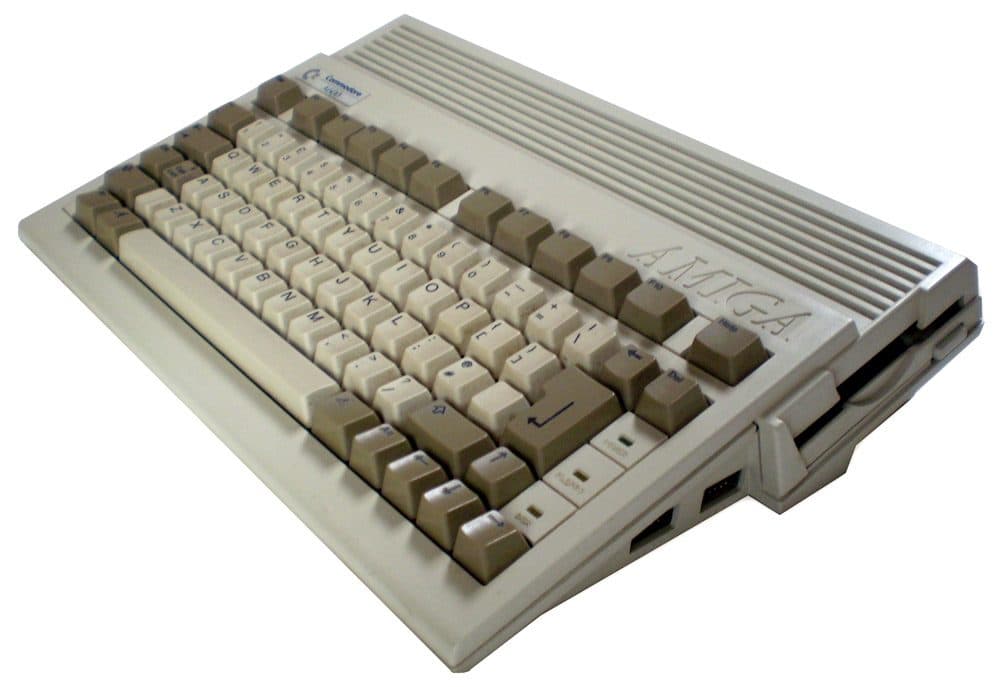 Amiga 600 · 1992
What it inherited from Gary
Under the novelties is the old Gary. Gayle generates DTACK for every cycle, four clock cycles by default, and lets XRDY delay it and OVR switch it off. It decodes the ROM at $F80000 and $E00000, Chip RAM in the first 2 MB, the chip registers at $DFF000, the CIAs at $BFxxxx, and the real-time clock, a Ricoh RP5C01, at $DC0000.
The ROM overlay changed place: in Gayle, OVL is internal. It is active at reset, so the ROM appears at address zero, and switches off on the first write to CIA-B. It is a detail that matters on the bench: in an A600 or A1200, OVL is not measured on a CIA-A pin as in the A500.
The reset comes from the keyboard: _KBRESET pulls the processor's reset and halt outputs, and an external reset clears all of Gayle's states. And the floppy glue is the same: the motor latched when the drive is selected, and the write signals buffered, all open collector.
Did you know…
The document was written in a hurry and never cleaned up: it has questions to the engineer George in the middle of the text ("what else is there to say?") and a "blah blah blah" in the environmental tests section.
PCMCIA is called "credit card" throughout the specification: that was the format's name before the PCMCIA association christened it.
Gayle provides for an SMC ARCNET network chip, the COM20020, with its own select. No production A600 or A1200 is known to have carried it.
In Gayle the ROM overlay at start-up switches off with the first write to CIA-B, not with CIA-A's OVL bit as in the A500.
The optional flash ROM was meant to replace the floppy drive in an even cheaper version of the A300, of which there is no record.
Faults it is part of
Diagnostic guides from the board explorer that measure this chip's signals, board by board.
Black screen, won't boot
The power light comes on but the screen stays black, with no colour at all. Measure in order: each step is only worth it if the previous one is fine.
Where it's found
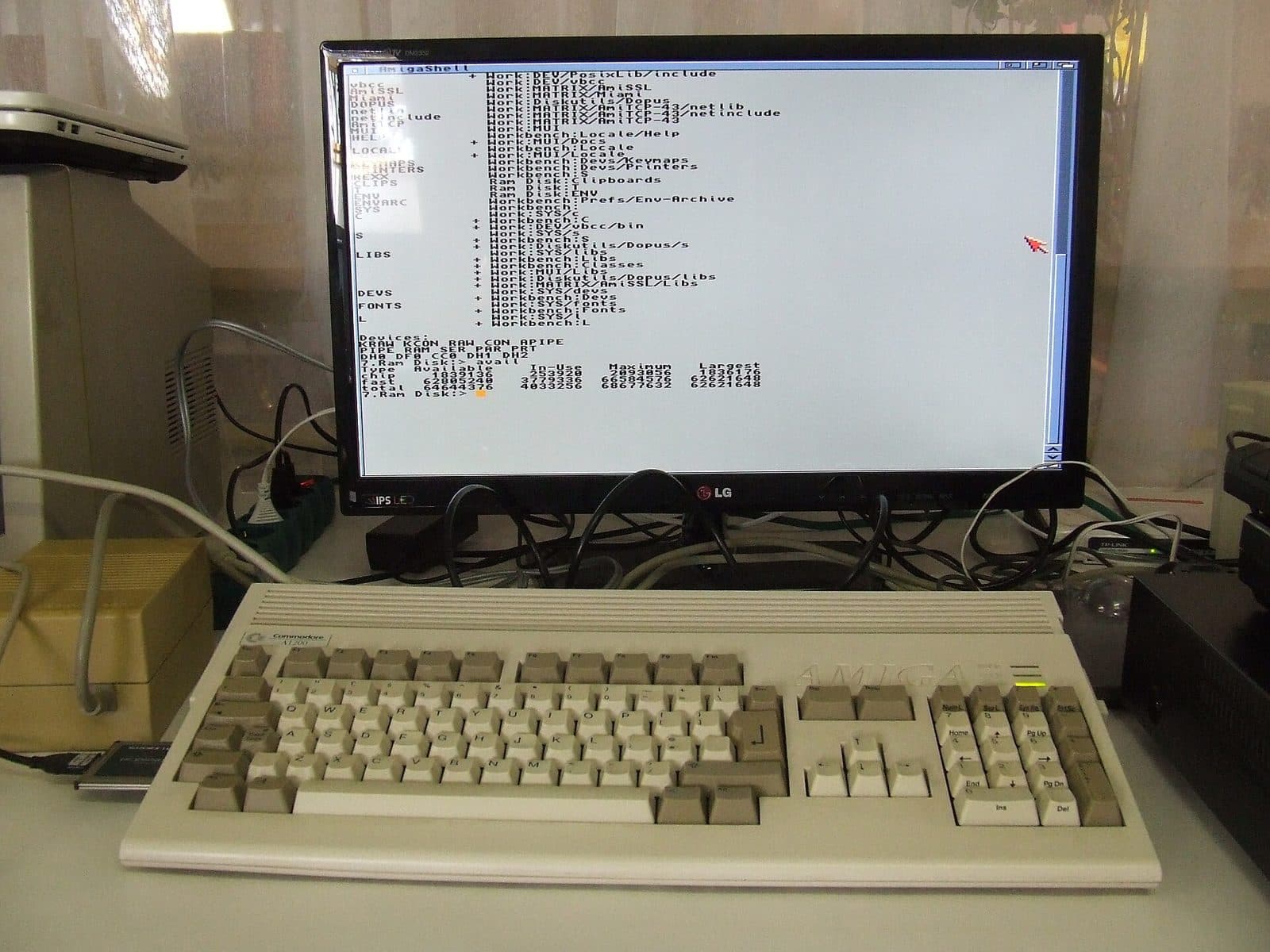
Sources
- [1]GAYLE Gate Array Specification (A300/A500+), 24 de junho de 1991 · Commodore-Amiga, 1991
- [2]Gayle Specification (cópia em PDF) · Commodore · amigawiki.org, 1991
- [3]A600 System Schematics (rev. 2) · Commodore · amigawiki.org, 1992
- [4]Amiga custom chips (números de peça do Gayle e do Budgie) · Retro Isle
- [5]Amiga custom chips · Wikipédia