QFP-160 · 391563-01 · drawing, not a photo
Amiga chipsCommodore
1993
Akiko
The CD32's own chip: it controls the CD, merges the logic of several chips and converts pixels into Amiga bitplanes.
Akiko is the chip Commodore created for the CD32, in 1993. It controls the CD drive, replaces logic that other Amigas spread across several chips, and does chunky-to-planar image conversion in hardware, useful for 3D games.
- 32
The last chip in the family
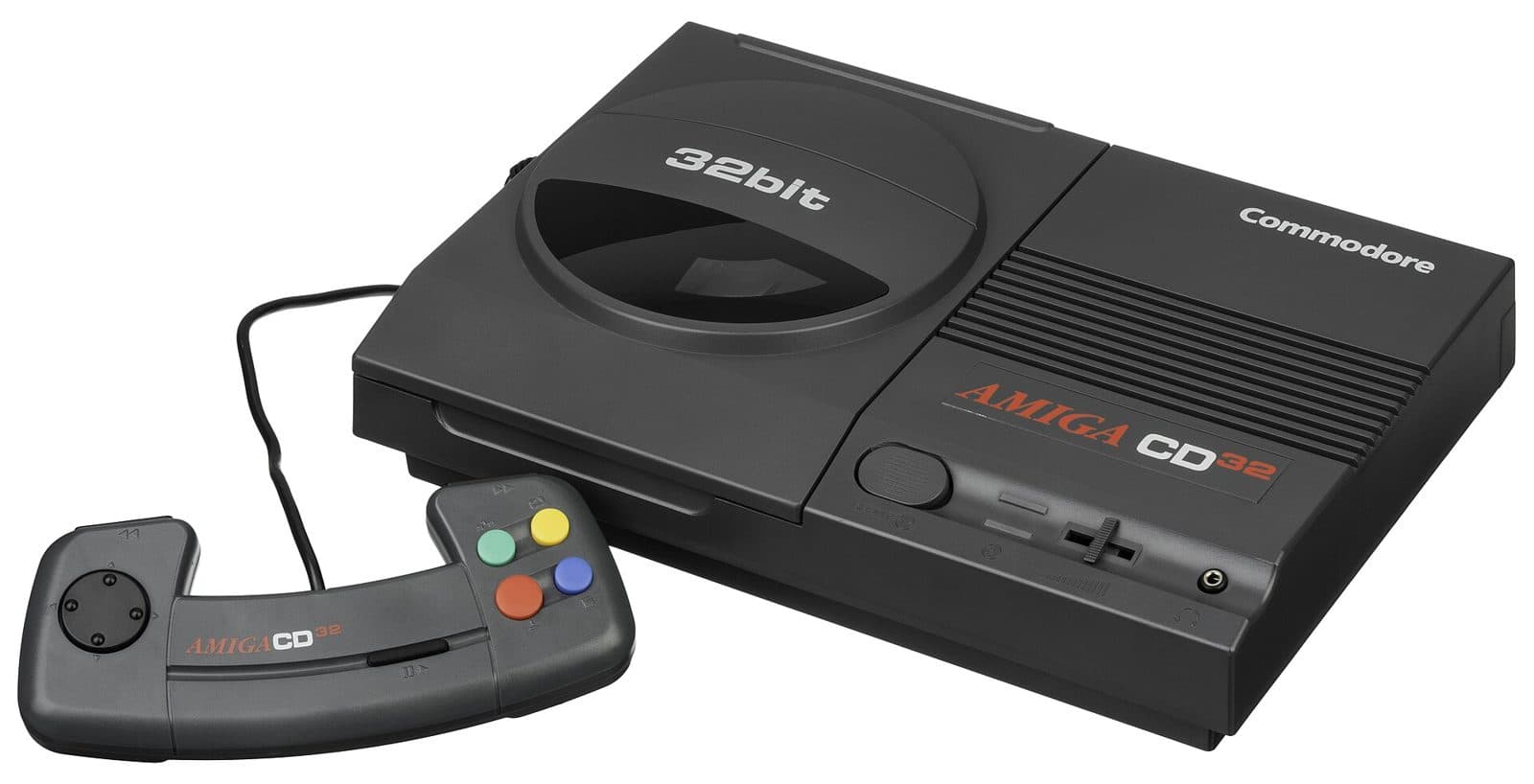
The CD32, codenamed Spellbound, is essentially an A1200 in console form: 68EC020, AGA chipset (Alice, Lisa and Paula) and 2 MB of Chip RAM. The new chip is Akiko, part number 391563-01, and it keeps up the tradition of female names, this time with a Japanese one.
It reached European shops in September 1993, eight months before Commodore went bankrupt, in April 1994.
One chip doing the work of many
Akiko absorbed the so-called glue logic: the functions that in the A1200 lived in Budgie, Gayle and the two 8520 CIAs. That includes the system timers, the two controller ports, the AUX serial port and control of the Chip RAM soldered to the board. That is why you won't find any CIAs on the CD32 board.
It also controls the double-speed CD drive (300 KB/s), with its own DMA that transfers sectors from the disc into memory. And it is through Akiko that the system talks to the small 1 KB EEPROM, a 24C08 chip connected over I2C, where games store high scores and saved games.
Chunky and planar, explained
As we saw with Denise and Lisa, the Amiga stores the image in bitplanes: on a 256-colour screen, the 8 bits of each pixel are spread across 8 different sheets. That is great for scrolling backgrounds and drawing with the Blitter. But a Doom-style 3D game calculates the image pixel by pixel and wants to write one byte per pixel, in a row: that is the chunky format.
Converting one format into the other means taking each byte apart and distributing its 8 bits across 8 planes, and on a 68EC020 at 14 MHz that eats a large part of the time for each frame. This is called chunky-to-planar conversion, or C2P.
Akiko does this shuffle in hardware. The processor writes 32 8-bit chunky pixels (eight 32-bit words) to a register, and reads back from the same register eight 32-bit words already arranged in planes, ready to copy to the screen.
How games used it (and why few did)
In practice, few games used Akiko's converter. Many CD32 games were versions of A500 and A1200 games, built for the Blitter and for bitplanes, which needed no C2P at all. The CD drive, on the other hand, always uses Akiko, whatever the game does.
Where it helped was in games and ports with 3D graphics calculated pixel by pixel. Even there the gain is real but modest: the processor still has to write the data to Akiko and read it back, and on a machine with an accelerator a good C2P routine on the processor can do the same job.
Kickstart itself supports the converter: it checks whether Akiko is present, by the signature it returns, before using it.
After the CD32
One of Commodore's last projects was the CD1200, an external CD drive for the A1200 with Akiko inside, which would have made any A1200 compatible with the CD32. It was never sold.
The CD32 hardware, with Akiko, also had a life away from living rooms: in 1993 the London Transport Museum installed 109 CD32s in its interactive exhibits, and in 1995 the Italian company CD Express used it as the basis of an arcade machine, the CUBO CD32.
Did you know…
If you read the first four bytes of Akiko's registers, at address $B80000, you get $C0CACAFE. Kickstart looks for the $CAFE before using the converter.
Only one surviving prototype of the CD1200, the Akiko-equipped CD drive for the A1200, is known. It is at the Retro Computer Museum in Leicester, in the United Kingdom.
Akiko converts 32 pixels at a time: eight 32-bit words go in in one format and eight words come out in the other, through the same register.
The CD32 board has no 8520 CIAs, the timer and port chips that every other Amiga has: that job moved inside Akiko.
The CD32's save-game memory is just 1 KB, in a small EEPROM chip, and it is Akiko that controls it.
In 1993, 109 CD32s showed animations, photographs and a London Underground simulator to visitors at the London Transport Museum.
There were CD32s in amusement arcades: the CUBO CD32 arcade machine, from 1995, was a stock CD32 connected to a board that adapted it to the arcades' JAMMA connections.
Chunky or planar?
The Amiga stores the picture in bitplanes: each pixel is spread across several planes, one bit in each. 3D games prefer one number per pixel (chunky). Akiko helped convert from one format to the other.